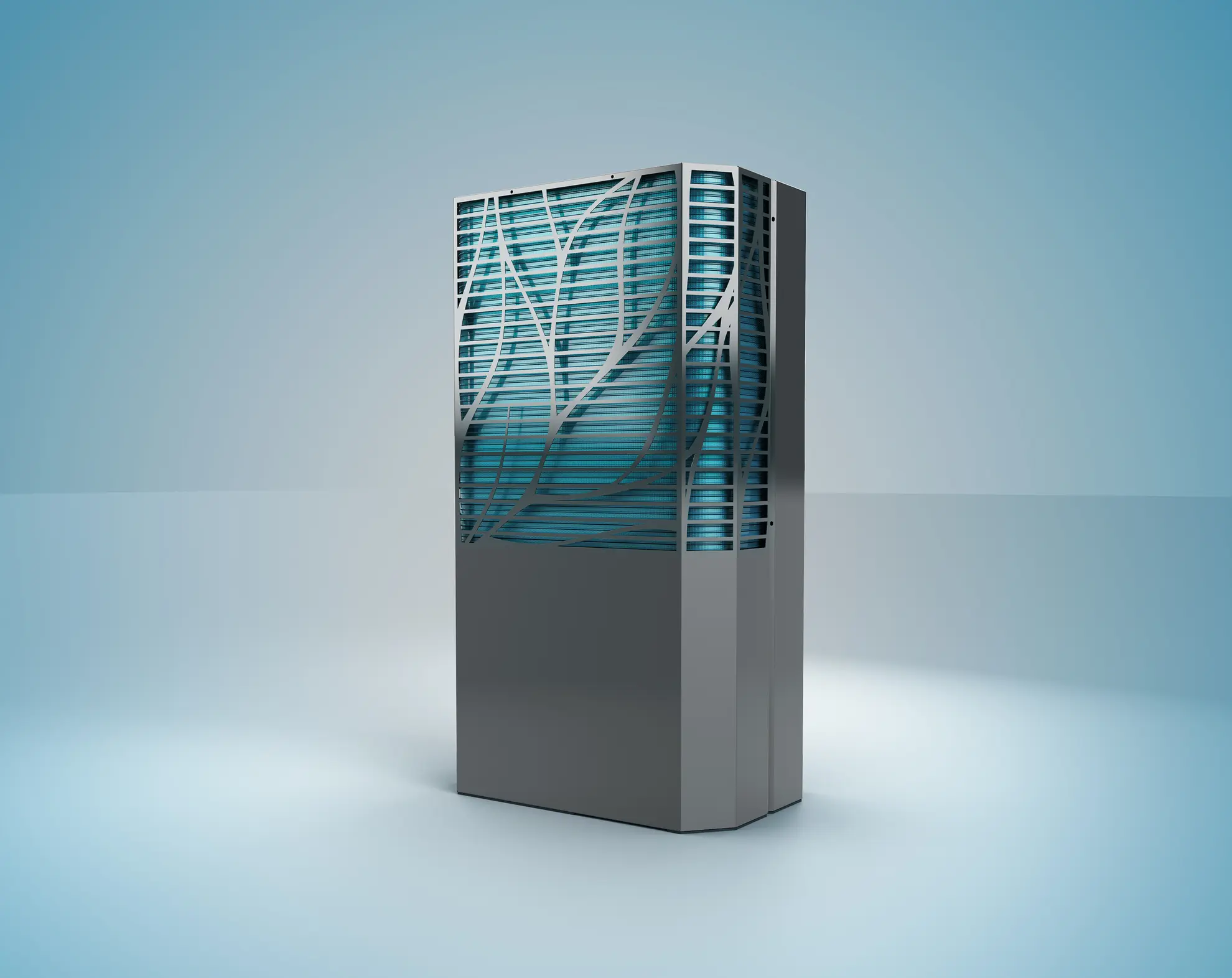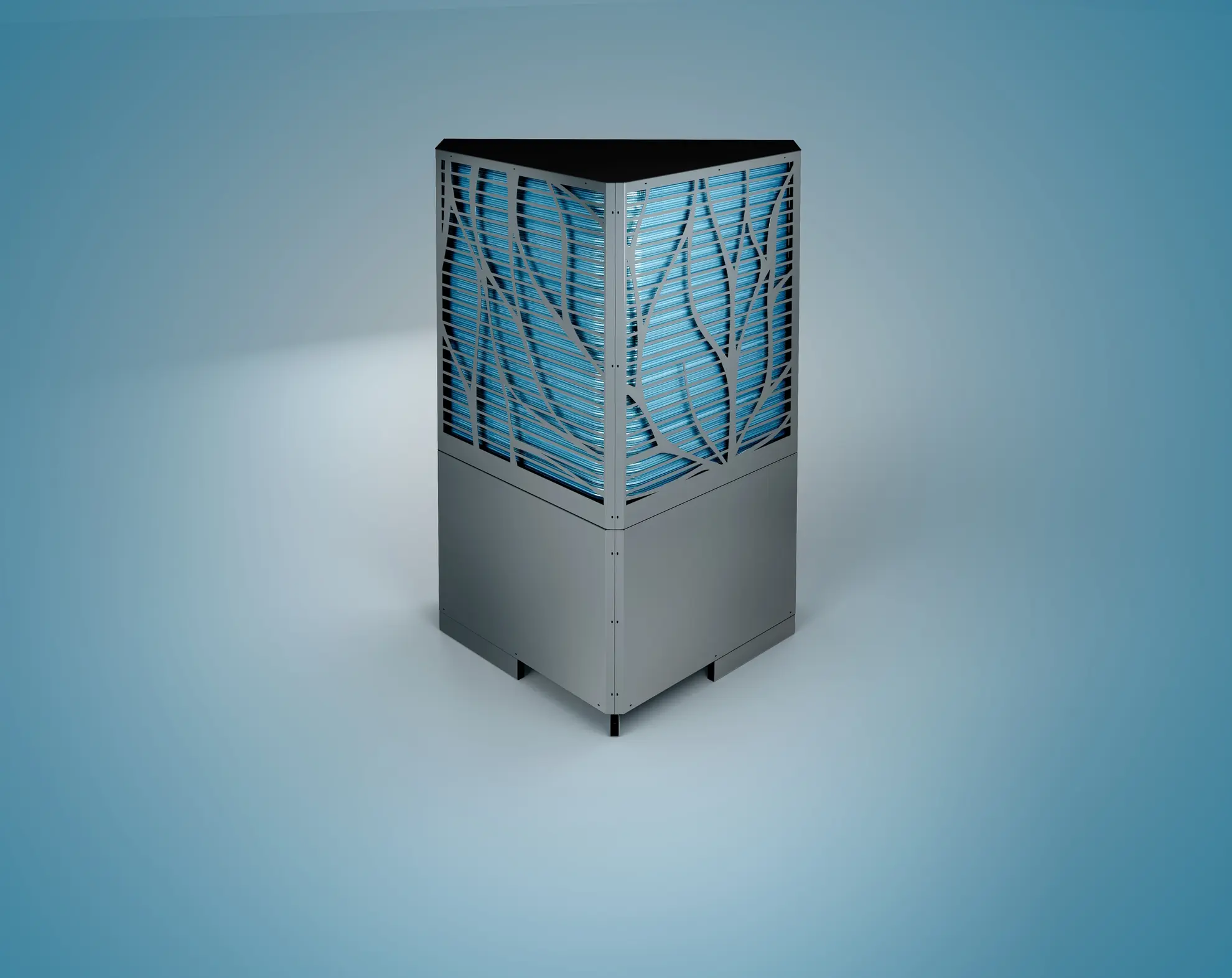

How does environmental energy enter the heat pump?
LAMBDA Heat Pumps has succeeded in significantly improving heat transfer between the energy source (air, ground, groundwater) and the refrigerant circulating within the heat pump thanks to optimized and patented flow mechanics. Heat transfer is thus increased by a factor of 4 to 6. On average, the evaporation temperature of the refrigerant in LAMBDA heat pumps is only 3 Kelvin below the energy source inlet temperature:
We call this the 3K Process®.
Conventional heat pumps have a relatively small heat transfer area between the energy source and the refrigerant circulating within the heat pump. As a result, free ambient heat is usually not utilized optimally—but this is not the case with our technology.

The 3K Process® for Air-Source Heat Pumps
The 3K-Process® has been successfully implemented in our Eureka-Luft (EU-L) series air-to-water heat pumps. Based on efficiency measurements conducted by an independent testing institute in accordance with EN 14825, it is clear that:
- Significantly reduced energy consumption
- Higher performance
- Fewer and shorter defrost cycles
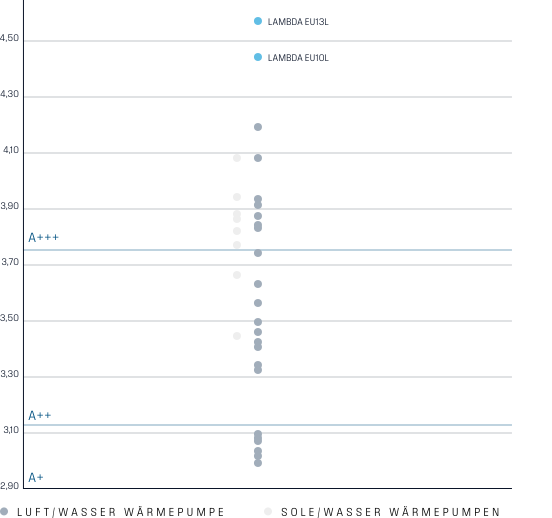
In short: over 30% less electricity consumption with the same heating capacity compared to the current highest energy efficiency standard for heat pumps, A+++!




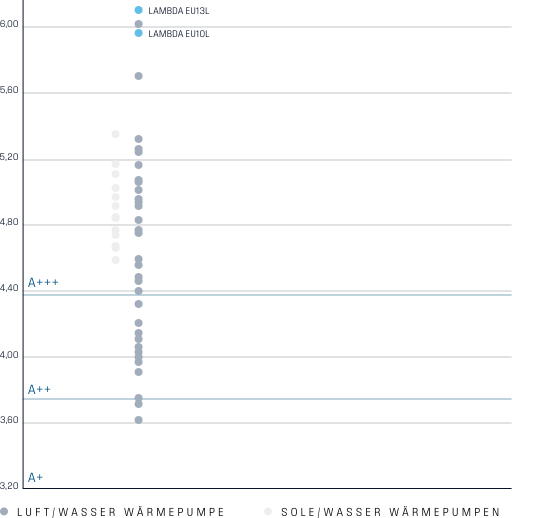
SCOP 6.10
The significant leap in innovation achieved through the development of the Eureka air-source heat pump series has also been confirmed by an independent body, the Heat Pump Testing Center (WPZ) in Buchs, Switzerland.
For both low-temperature applications (35°C) and high-temperature applications (55°C), the seasonal coefficient of performance (SCOP) of the LAMBDA Eureka air source heat pump ranks at the top of the efficiency scale. In fact, it outperformed all brine/water heat pumps tested at the WPZ.


Quiet but powerful
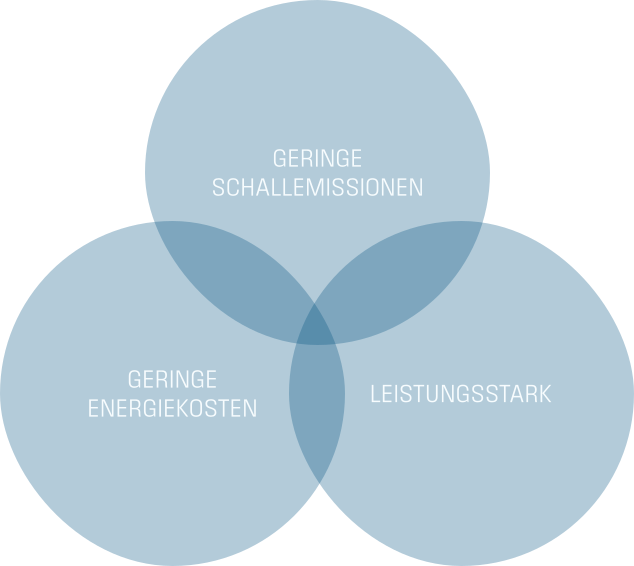
With our Eureka Series heat pumps, we have succeeded in combining whisper-quiet operation with maximum energy efficiency.
The main sources of noise in a heat pump are the compressor and, in the case of air-source heat pumps, the fan. A popular and simple way to reduce noise emissions from heat pumps is to limit the power output of these components. However, this inevitably leads to higher energy costs and reduced performance.
“So is quiet operation of heat pumps only possible at the expense of energy efficiency?” We at LAMBDA Heat Pumps say: NO!
A variety of technical refinements ensure this.
Technical innovations from LAMBDA heat pumps:
- Bionically optimized fan blades
- 20% noise reduction achieved by enlarging the fan blades
- Evaporator geometry optimized for pressure loss
- Double structural noise decoupling
- Triple sound enclosure for the compressor
- Noise projection reduction
- Demand-based, predictive speed control
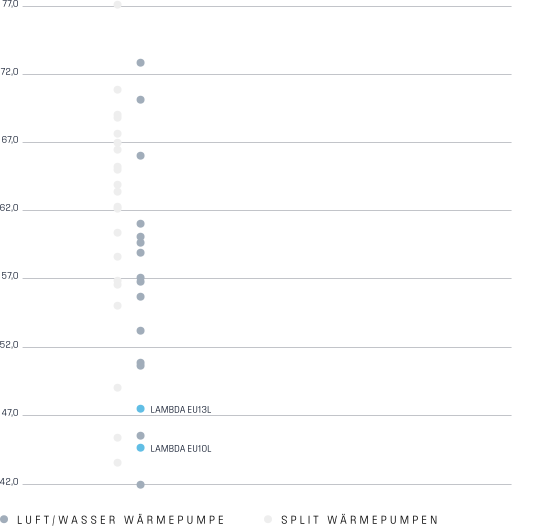
Tests of the sound power level in accordance with EN 12102 at the Buchs Heat Pump Test Center show that units in the EU-L series are among the quietest air-source heat pumps on the market.
Source: Buchs Heat Pump Test Center – List of tested heat pumps (as of January 2026).

Heat Pumps in Existing Buildings
The efficiency advantage of Eureka air-to-water heat pumps: LAMBDA heat pumps are designed for flow temperatures of up to 70°C. This means our heat pumps can be used in existing buildings in a way that makes both environmental and economic sense. In other words: LAMBDA air-to-water heat pumps achieve the same efficiency ratings in existing buildings with radiators as other A+++ air-to-water heat pumps do in new buildings with underfloor heating.

LAMBDA heat pumps are designed for flow temperatures of up to 70°C. This offers several advantages. For example, they can also be used with heating systems that require very high temperatures of up to 70°C. Many current heat pump systems can only provide temperatures above 60°C with the help of an electric auxiliary heater.
Our heat pumps heat drinking water to over 60°C without the need for additional electric heating or extra energy costs, thereby providing effective protection against Legionella.
Legionella are pathogens that, in high concentrations, can cause severe pneumonia. The bacteria thrive in stagnant fresh water at temperatures between 30°C and 50°C. These conditions are often found in hot water storage tanks. The most effective protection against Legionella is thermal disinfection, which requires heating the drinking water to over 60°C.
Heat pumps and solar power systems complement each other perfectly, as the electricity generated on-site can be used directly for heating and cooling the building as well as for heating domestic hot water. The hot water tank plays a central role in this process; when electricity production is high, it can be heated to up to 70°C, thereby contributing to energy self-sufficiency as a form of energy storage.
LAMBDA can do even more!
Heating in winter and cooling in summer. With LAMBDA heat pumps, this is no problem—and it’s even included as standard in the Eureka-Luft series.
With our highly secure, end-to-end encrypted remote access, you’re always in control, no matter where you are.
With the exception of the 7-inch touchscreen, the entire unit is located on the outside. This saves a lot of space that you can use as living space.
Increase the self-sufficiency of your solar power system. Through intelligent load management, we proactively use excess solar power for building heating and hot water.