

A heat pump is a system that absorbs heat at a low temperature and releases it at a high temperature. This makes it possible to extract energy from a cooler environment (e.g., air, soil, or groundwater) and transfer it to the heating system at higher temperatures. This principle is also used in every refrigerator. Heat is extracted from the refrigerator and released into the room through the back panel. The fundamental difference between a heat pump and a refrigerator lies in how they are used. While the heat pump utilizes the warm side of the process for building heating, the refrigerator focuses on the cold side.
Heat Pumps Explained Simply
Technical terms in heating engineering
Technical Terms, Abbreviations, and Physics – We explain the most important terms in the heating industry and help you stay well-informed.
Buying a heating system is usually a long-term investment; being well-informed makes it easier for you to choose the right heating solution and also helps you save money when purchasing a heat pump.
Electricity is required to operate a heat pump. In this context, the “Coefficient of Performance” (COP) is often used as a measure of efficiency. It represents the ratio of the available thermal energy to the electrical energy required to produce it. A COP of 6 means that 6 kW of heat is generated from 1 kW of electricity. The difference—5 kW—comes from free ambient heat!
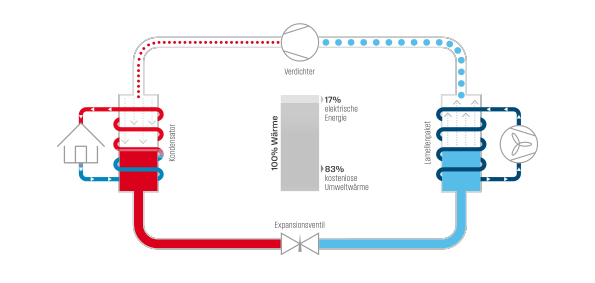
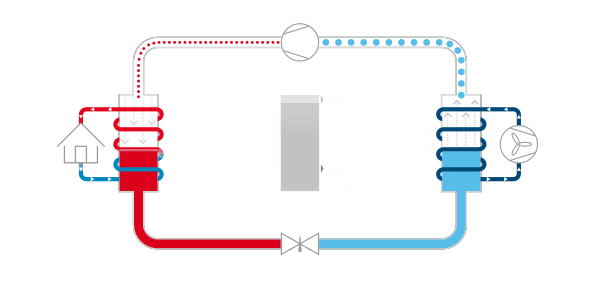
The smaller the temperature difference between the heat source (e.g., air) and the heat sink (heating system), the more efficiently and economically the heat pump can operate. For air-to-water heat pumps, this means: The higher the outdoor air temperature and the lower the temperature in the heating system, the better. Thus, with LAMBDA heat pumps, COPs of over 8 can be achieved at low flow temperatures (as is the case in underfloor heating systems) and high energy source temperatures (e.g., 15°C outdoor temperature). Even under difficult conditions—that is, high flow temperatures (over 60°C) and very low energy source temperatures (e.g., -20°C)—a COP of over 2 is still achieved.
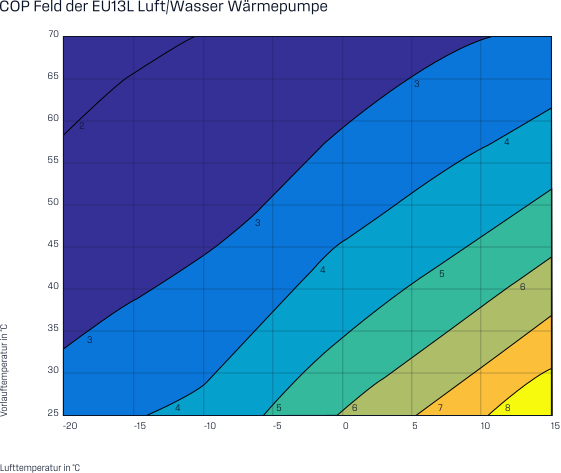

The temperature of the energy source depends on the type of heat pump:
- Air-source heat pumps: Varies depending on the outdoor air temperature. On average, between 0 and 5°C during the heating season.
- Groundwater heat pumps: Constant at 8 to 12°C throughout the year
Ground-source heat pumps: Constant between 0 and 5°C throughout the year
To enable a comparison between different types of heating systems, the so-called SCOP (Seasonal Coefficient of Performance) was introduced. This metric describes the average COP over the course of a year for a reference heating system in a reference climate region. The SCOP is thus an indicator of the heat pump’s energy efficiency over the course of a year and is specified by the manufacturer for various heating systems and climate regions.
The annual performance factor (APF) is the actual prevailing heat demand relative to the electricity demand over the course of a year for an existing heat pump system. The APF is, so to speak, the SCOP measured in practice.